

Podcast Episode Explores Science Fair Culture at Chilliwack Secondary
Students present 50 projects at the school's 2026 Science Fair
April 20, 2026
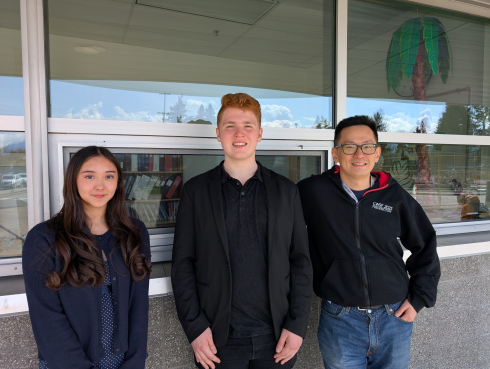
Chilliwack Secondary School (CSS) science teachers Avril Broekhuizen and Scott Liang recently joined host Michael Unger on the podcast Let's Innovate. The teachers spoke about the challenges and rewards of building a culture around and organizing a school science fair.
Unger is a science communicator and the manager of community engagement for the BC Science Fair Foundation.
In their interview, Broekhuizen and Liang reflected on how science courses and the science fair at CSS have evolved over the years. The school introduced a Science 9 Honours course in 2007. Since then, the science department has built a culture around scientific inquiry, hosting their own science fair each year since 2008.
Before he became a teacher, Liang was a master’s student doing research at UBC. He immersed himself in scientific inquiry and the scientific method of learning. When he started teaching Science 10 Honours at CSS in 2020, he wanted to bring his experience at UBC into the classroom.
“A science fair is a way to foster relationships with students. It gives teachers a lot of opportunities to have genuine conversations to find out what students are passionate about,” said Liang. “Those relationships are very valuable in terms of student learning and being able to take them to the next level of thinking.”
He says the language around science experiments and inquiry is changing in a way that helps students to think more broadly about their science fair projects.
“We are not just doing traditional experiments anymore,” said Liang. “I think the language has a very big impact on how students treat a science fair. With STEM and STEAM, we encourage students to think beyond what we’re doing in the classroom. Let’s do something engineering; let’s do something design.”
The 2026 science fair was Chilliwack Secondary's biggest yet with 65 students presenting 50 projects. This year, students presented a range of projects using various formats and models.
One project examined how light pollution affects bird migratory paths through a review of published studies. Another project featured an experimental investigation into slime mold behavior and its response to different food sources. Several projects highlighted innovative thinking and real-world applications. One student designed a mobile app connected to a soil sensor that provides notifications when plants need watering. Another explored the potential of recycling plastic bottles into 3D printing filaments.
The fairs give students the opportunity to practice time management, to learn how to search for resources, to develop problem-solving skills, and to ask good questions. They are also able to earn two Independent Directed Studies (IDS) credits for their projects.
“With this year’s projects, we saw so many more projects that included learning from other subject areas. You saw kids that had their computing backgrounds and their art and design backgrounds really making their way into the projects,” said Broekhuizen.
“I think there’s an increasing appetite for really being mentored and pursuing ideas and topics that are meaningful to individuals. As their eyes are opened to new problems and issues, they get inspired.”
Students Asya Iwasaki and Miles Smith were also interviewed. Both students received awards at the Fraser Valley Regional Science Fair.