

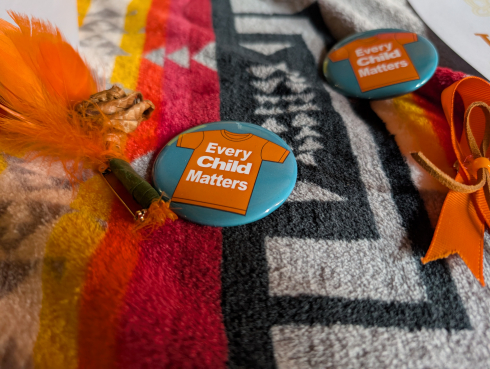
District Message on the National Day for Truth and Reconciliation
September 30, 2026
On this National Day for Truth and Reconciliation, we pause to remember and honour the children who never returned home from residential schools, the Survivors who carried these experiences with them, their families, and the generations who continue to live with the impacts of these systems.
This day calls us to confront the truths of Canada’s history with open hearts and minds. Residential schools sought to erase Indigenous cultures, languages, identities, families, and ways of knowing and being. Their legacy did not end when the last school closed. The impacts of colonialism, systemic racism, and intergenerational trauma continue to be experienced within our communities and within our education system today.
Truth must come before reconciliation. This requires each of us to continue learning, listening to Survivors and Indigenous Peoples, examining our own assumptions and biases, and understanding the responsibilities we carry in the places where we live, learn, and work. But remembrance and reflection, while essential, are not enough.
Dr. Niigaan Sinclair, an Anishinaabe scholar from Peguis First Nation, challenges education systems to consider whether Indigenous education has truly become part of who we are or remains something that can be added or removed. As he reminds us, “If Indigenous education can be cut without consequence, it’s not truly integrated.”
Sinclair describes a journey from presence, to practice, to pedagogy, and ultimately to permanence. Presence matters. Orange Shirt Day, ceremonies, territorial acknowledgements, and opportunities to learn from Elders and Knowledge Keepers create important moments for learning and reflection. Yet the deeper responsibility is to ensure that this learning does not remain confined to a particular day, event, classroom, or individual. It must increasingly become woven into how we teach, how we learn, how we build relationships, and how we understand our responsibilities to one another.
For us in the Chilliwack School District, this means continuing to work alongside local First Nations, Indigenous Rightsholders, families, Elders, Knowledge Keepers, students, and community partners. It means creating learning environments where Indigenous students do not have to choose between success in school and who they are, and where their culture, language, identity, knowledge, and ways of being are respected and valued. Sinclair reminds us that responsibility requires more than good intentions. It requires us to ask whether our actions are making a meaningful difference and to remain committed to reflection, learning, and continuous improvement.
National Day for Truth and Reconciliation provides an important moment to pause. Our greater responsibility is what happens after September 30.
Reconciliation is ongoing work. It is found in the relationships we build, the decisions we make, what and how we teach, whose voices we listen to, the barriers we remove, and the conditions we create for Indigenous students to experience belonging and flourish.
As we continue this journey together, may we approach this responsibility with humility, courage, kindness, and a willingness to keep learning. Most importantly, may we ensure that truth and reconciliation become not simply something we acknowledge, but something increasingly reflected in who we are and how we live and learn together.